Your AI Usage Policy Is Now a Legal Document
If your organization doesn't have a written AI usage policy, you're exposed. Here's why it matters, what it needs to cover, and how it protects you when a data handling question inevitably comes up.
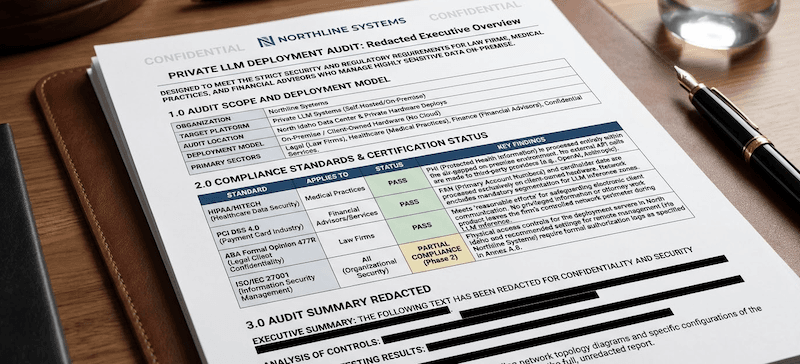
Two years ago, an AI usage policy was a nice-to-have. Something forward-thinking companies put together because it seemed responsible. Today it's a legal document - and not having one is an active liability.
Here's why, and what yours needs to contain.
Why it matters now
Three things changed:
1. Your employees are already using AI
This isn't speculative. Studies consistently show that 60-80% of knowledge workers use AI tools at work, and most of them haven't told their employer. They're using ChatGPT, Claude, Gemini, and Copilot to draft documents, summarize data, and answer questions - often with company or client data.
Without a policy, they're making their own judgment calls. And their judgment is: "This saves me two hours and nobody said I couldn't."
2. Regulators are paying attention
State bar associations are issuing AI guidance for attorneys. HHS is clarifying HIPAA's application to AI tools. The SEC is examining AI usage in financial services. State legislatures are passing AI transparency and data handling laws.
The regulatory direction is consistent: organizations are expected to know how AI is being used with their data, and to have documented controls in place.
3. Liability follows the gap
When a data breach or compliance violation occurs because an employee used an AI tool inappropriately, the first question will be: "Did the organization have a policy?" If the answer is no, the liability argument writes itself. The organization knew AI tools existed, knew employees had access to them, knew they handled sensitive data - and did nothing to provide guidance.
That's negligence in most legal frameworks. A written, enforced policy is your primary defense.
What a policy needs to cover
An effective AI usage policy isn't a one-page memo that says "be careful with AI." It's a specific, actionable document that your team can follow without interpretation.
Approved tools
List every AI tool that is approved for use in your organization, and specify what each is approved for:
- Tool X: Approved for general research, marketing copy, and internal documentation. Not approved for client data, financial records, or privileged communications.
- Private AI Portal: Approved for all data types including privileged, regulated, and confidential data. Processed locally on company infrastructure.
If a tool isn't on the approved list, it's not approved. Period.
Data classification tiers
Define clear categories so employees can quickly determine what data can go where:
- Public: Information that's already publicly available. Safe for any AI tool. Examples: published regulations, public company filings, general research questions.
- Internal: Company information that isn't client-specific or regulated. Approved cloud AI tools only. Examples: internal process documentation, meeting agendas, marketing drafts.
- Confidential: Client data, financial records, privileged communications, competitive intelligence. Local AI infrastructure only. Examples: client contracts, patient records, financial statements, bid pricing.
- Restricted: Data with specific regulatory requirements. Local AI infrastructure only, with additional access controls. Examples: PHI under HIPAA, CUI under CMMC, data under active NDA with specific handling requirements.
Prohibited actions
Be explicit. Employees need to know exactly what they cannot do:
- Do not paste client names, case numbers, or identifying information into any cloud AI tool
- Do not upload client documents to cloud AI tools
- Do not use cloud AI tools to draft documents containing privileged or confidential information
- Do not use personal AI accounts for any work-related tasks
- Do not use AI-generated output in client deliverables without review and verification
Incident reporting
What happens when someone accidentally puts sensitive data into a cloud AI tool? They need a clear process:
- Stop using the tool immediately for that task
- Report the incident to [designated person/role] within 24 hours
- Document what data was shared, which tool was used, and when
- Do not attempt to "fix" the issue by deleting chat history (this may not actually delete the data from the provider's servers)
The reporting process should be blame-free. Employees who report incidents promptly should not face disciplinary action for the initial mistake. Employees who fail to report should.
Verification requirements
AI output is not automatically trustworthy. Your policy should specify:
- All AI-generated documents must be reviewed by a qualified human before use
- AI-generated legal documents must be reviewed by a licensed attorney
- AI-generated medical documentation must be reviewed by the treating provider
- AI-generated financial analysis must be verified against source data
- Citations, case references, and factual claims must be independently confirmed
Consequences
A policy without enforcement is a suggestion. Specify what happens when the policy is violated:
- First violation (inadvertent, reported promptly): Retraining
- First violation (not reported): Written warning
- Repeated violations: Escalating disciplinary action
- Intentional misuse of client data: Termination and potential legal referral
How to implement it
Step 1: Assess current usage
Before writing the policy, understand what's already happening. Survey your team. Check browser histories if appropriate. Review tool subscriptions. You can't write an effective policy without knowing what you're addressing.
Step 2: Classify your data
Map every data type your organization handles. Assign each a classification tier. This becomes the foundation of the policy - employees reference the classification to determine how to handle each type of data.
Step 3: Write the policy
Use specific, unambiguous language. Avoid jargon. Include examples. The goal is that any employee can read the policy and know exactly what they're allowed and not allowed to do.
Step 4: Train your team
A policy that lives in a shared drive is worthless. Every employee should:
- Read the policy
- Acknowledge it in writing
- Complete a brief training session with real-world examples
- Know who to contact with questions
Step 5: Enforce and update
Review the policy quarterly. AI tools and regulations change rapidly. Your policy needs to keep pace. Audit compliance periodically - not punitively, but to identify gaps in understanding or new tools that need to be addressed.
What we deliver
Our AI Operations Audit includes a written AI usage policy tailored to your organization. Not a template - a document based on your actual data types, your team's current AI usage patterns, and your specific regulatory requirements.
The policy is one deliverable among several: you also get a security assessment, data classification framework, and a working prototype of your first private AI automation.
$3,500 for the audit. Credited toward a build if you proceed.
Book a 15-minute call and we'll discuss what your policy needs to cover.
Related reading:
Want to see what AI can do for your business?
Book a free 15-minute call. We'll tell you exactly what's automatable — and what isn't.
Schedule a 15-Minute Fit Call